Communicate, Educate, Advocate
It is an honor to be nominated for President-Elect in such interesting times. The need for active scientists, a robust academic and industrial enterprise, and an educated public is compelling. The ACS is uniquely positioned to enable us to advance chemistry in these areas…but only if we step up. We as a Society need to tell our story—to communicate, educate and advocate. I have done this throughout my career as I led academic and ACS units through challenging times. I was Chemistry Department Chair in a large research-intensive university during the COVID pandemic. Not only did our teaching and research missions thrive but while other institutions were retrenching and doing more with less, I hired 22 new Chemistry faculty (mostly tenure-track) during my Chair term. During my leadership roles – as an Associate Dean, a Department Chair, Director of an NSF-CCI Center, Technical Division leadership in the ACS – I have stayed in the trenches as a research-active chemist, mentoring 75 graduate students, 26 postdoctoral fellows, and more than 100 undergraduate researchers; publishing 200 papers (mostly in ACS journals) and giving more than 220 invited research talks on six continents. I have also maintained an international research presence as a member of three EU Cooperation in Science and Technology Actions and an EU Innovative Training Network. Now, I want to use my skills and the resources of the ACS to join with you to tell our story about the value of chemistry as the central science.
Communicate. We are outstanding in our scientific communications through the ACS journals and conferences. Let us maintain that excellence and also use our skills to reach out to the public. Is your passion live events such as Science Cafes? Providing tours of your company's facilities? Social media? Podcasts or videos? Something new? We need to engage our fellow citizens, and I am committed to supporting development of creative new outreach programs. Do you enjoy explaining complex concepts to a non-expert audience? Let us refresh and expand the list of volunteer ACS Experts who provide information for the media and our elected officials. As ACS President, I will be out there telling the story. Find your passion and come with me out into the community!
Educate. The ACS has long been the advocate for high standards in chemical education. I know this from my service on the ACS Committee on Professional Training. We can maintain this quality while supporting innovative curriculum development at both the undergraduate and graduate levels. I am committed to support efforts that include broad perspectives from academics, industry and the public sector, so that we can prepare our students with both chemistry expertise and the broader skills necessary to succeed in an increasingly complex and interdisciplinary global workforce. Not all education is done in the classroom. As we rethink education, we should incentivize experiential learning such as internships, study abroad, student outreach, professional development, and mentoring programs for new faculty and early career industrial chemists. These are critical for training the next generation. Those of us with more experience have an obligation to pass along what we have learned, and I will champion these efforts.
Advocate. First, we must advocate for each other and for the ACS. We can bring in additional members to strengthen our community. We can participate in local section activities. Despite the current climate, diversity is still a good thing. We can be welcoming to all of us. We can support the affinity groups within ACS. Then, as a cohesive group of chemists, we can turn our attention outward to engage in broader advocacy. The ACS has a robust advocacy program in Washington DC that addresses policy at the federal level. This is extremely important, and it is a top priority for me. However, there is more to do. It has been said that all politics is local. The same advocacy strategies ACS uses in Washington can be used by local sections to engage with school boards, local governments, and regional commissions to address issues that are science related. Let's do it!
As we tell our story: communicate, educate and advocate, the ACS has resources to utilize. Use them as a starting point. We will develop more resources as we go. Come with me. We can make a difference.
I would love to hear from you. Please feel free to contact me with questions or ideas. I can be reached on LinkedIn, on Bluesky @McElweeWhite, by email at LisaMcACS@gmail.com, or here on the website LisaMcACS.org.
Campaign Newsletter - August 21
When I was asked to run for ACS President-Elect, I thought about what I could do to make a difference. In this age of widespread misinformation and skepticism about science, I decided to make science communication the focus of my candidacy. We need to tell our story: communicate with our neighbors, educate our students and elected officials, and advocate for science wherever we can. Honestly, efforts in any of these areas would have value. I'm interested in public outreach, chemistry curricula, advocacy strategies, effective safety training, and a lot of other things. There is a whole world of choices on where to start.
But I also have learned something from having led organizations of different types. I have chaired an academic department with ~500 people on the payroll, chaired an ACS technical division that had >16,000 members at the time, served as director of an NSF-CCI research center, and run a research group of 20 students. As a result, I have been part of many really amazing things...and some of them were even my idea. Most of them weren't. Having lots of smart, creative people in your organization means those people are going to generate lots of great ideas. As a leader, I provide a conceptual big picture, encourage people to imagine great things, look at the budget, do some triage, and provide resources (as I can) to enable them. The ACS is full of wonderful creative people who generate terrific ideas. You can see where this is going.
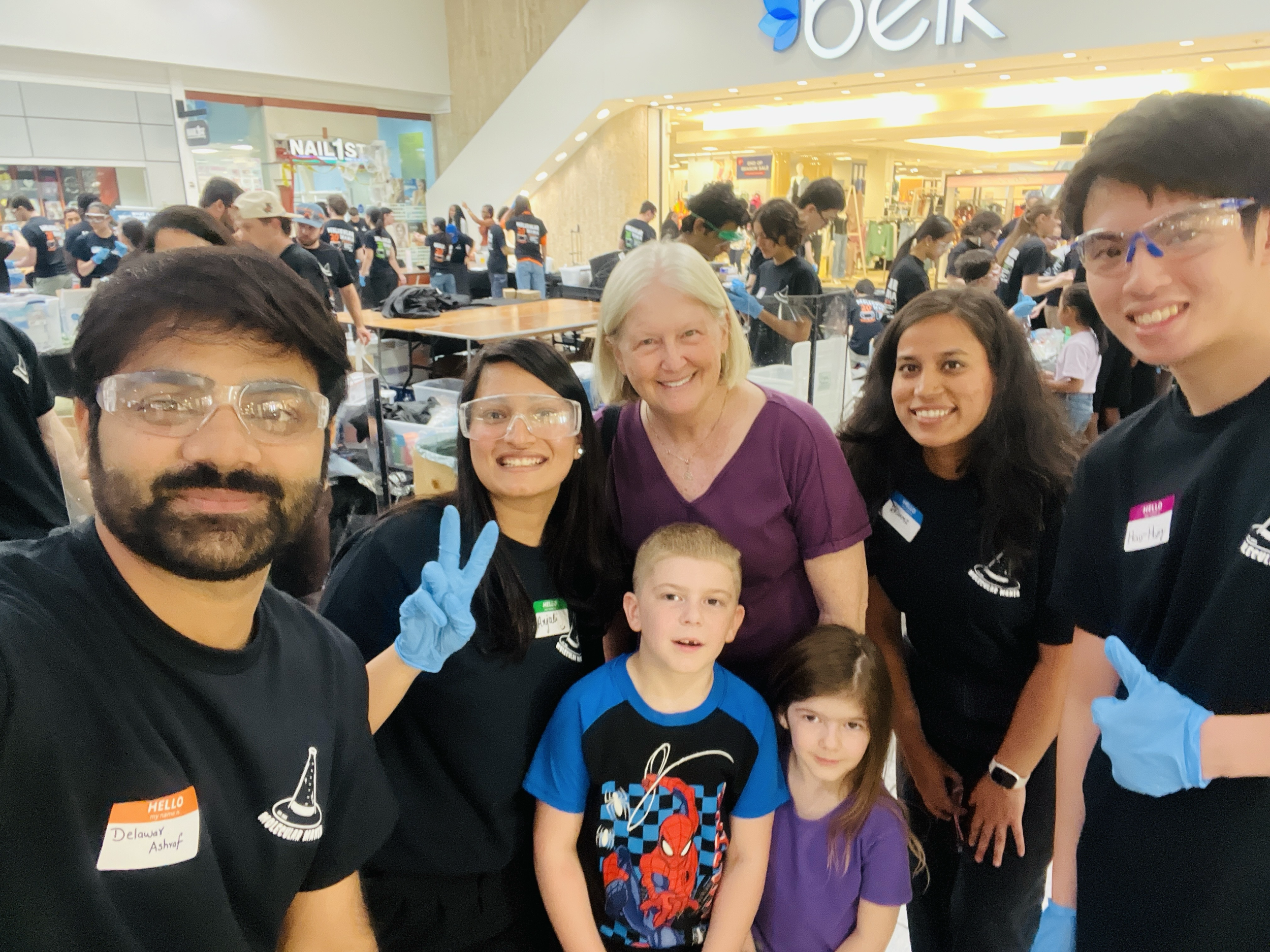
The photo was taken at an outreach event for kids that started with a great idea from one of my colleagues and is now in its 21st year. The student volunteers in the photo are members of my research group, and the little critters are my grandchildren.
This is where I ask you to tell me what the ACS should be doing for science communication. The future chemists in the photo are why we need to get it right. On my website LisaMcACS.org, there is a "contact" page where you can reach me. I'm listening!
Campaign Newsletter - September 14
As a candidate for 2027 ACS President-Elect, I have been thinking about where the ACS should put its efforts in the future. We, as the ACS, should still serve our members and provide benefits, a sense of community, educational materials, and scientific communication through meetings and publications. That has not changed. However, the political climate for science has been changing fast and the ACS must respond to outside forces. My platform of communicate, educate, advocate still has it right but we need to turn our attention more outward toward issues of public policy and global engagement with international chemistry colleagues.
What do I bring to the table that could advance these goals? As a university administrator, I gained experience with development work, convincing both individual and corporate donors of the value of financially supporting chemistry at my institution. I know how to sell the value of science and I know how to utilize resources that result from these efforts. Likewise, I have interacted with state and local elected officials on matters that concerned science and my institution. I know how to discuss public policy with decision makers.
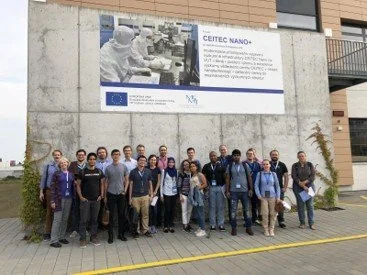
At a moment when the ACS is rightfully emphasizing its global reach, I also bring an established international presence. Yes, I am an ACS Fellow but I am also an IUPAC Fellow, who has presented talks on six continents. I have been a non-EU member of three EU COST Actions (research centers) and an EU Marie Skłodowska-Curie Innovative Training Network (ITN). The photo was taken when I was in Brno, Czechia as an instructor for a Technical Training School for graduate students supported by the ITN. These international activities have resulted in my current scientific collaborations with colleagues in seven different countries. I know how to make productive connections with international scientists in chemistry and related fields.
I believe we can bring the ACS further into the national and international conversation about the future of science while preserving the member features we value. Come with me and let's do this!